Posts

Exploring Atomic Structure & Electromagnetic Radiation
Image
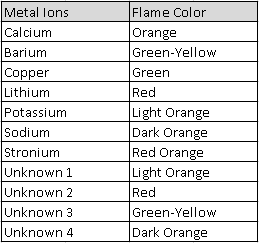
Exploring Atomic Structure & Electromagnetic Radiation    The question we were trying to answer was "What are the identities of the unknown solutions?" The reason we were trying to answer this question was to get a better understanding of the unique colors each one emits. During our investigation we had seven wood sticks soaked in the solutions CaCl, BaCl, CuCl, LiCl, KCl, NaCl, SrCl, and four soaked in a unknown solution. We took each solution soaked stick, tested them in a flame test and observed the colors each one produced.    Claim: Unknown 1: Potassium, Unknown 2: Lithium, Unknown 3: Barium, Unknown 4: Sodium    Evidence:    Reasoning: Our reasoning is that 1, 3, and 4 are different shades of orange and green. Ion 2 matched the color lithium produced when it was put under fire. A flame test is used to determine the metal ion based on the color it produces. It produces color because the electrons become excited by the...
Exploring Isotopes & Average Atomic Mass

Image
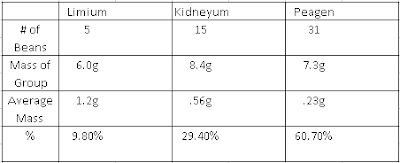
Exploring Isotopes & Average Atomic Mass   The question we were trying to answer was "What is the atomic mass of beanium". During our investigation we separated the three different types of beanium, counted them, and then took the mass of each type in groups. We weighed it this way because each bean is not same, but we want them to be. We got the mass of each group and divided it by the number of beans to get the mass of an individual bean.   Our claim was that the atomic mass of beanium is .42g. Evidence:                                                   =.42g   Our reasoning is we took the average mass of bean and multiplied it by the abundance(percent) and added each one than divided by 100. for this we got the atomic mass of beanium as .42g. We took the average mass of the beans because we want them to weigh t...

Exploring Changes in Matter Lab

Exploring Changes in Matter    The question we were trying to answer was "Which changes are examples of a chemical change, and which are examples of a physical change". During our investigation we had five different scenarios where we had to combine two substance or add heat to a certain one. We observed and wrote our observations in our notebook of each scenario to determine which were an example of a chemical or physical change. We divided up each scenario between us and then conducted the experiments.     Our claim was that the water/salt and the paraffin wax were physical changes and the copper wire, sodium hydroxide/copper nitrate and the hydrochloric acid/sodium bicarbonate were chemical changes. Evidence: Scenario #1 Water/Salt: The salt dissolved into water, giving it a foggy color. Scenario #2 Copper Wire: We placed it into a crucible and heated it with a Bunsen burner and it changed               ...
Image
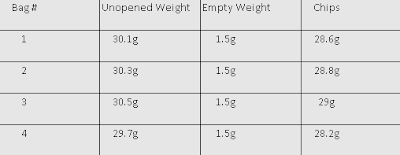
Exploring Measurement in the Food Industry The question we were trying to answer was "Do you get what you pay for"? We were investigating to see if the weight of the chips matched the net weight listed on the bags by weighing the bags with and without their contents(Net Weight 28.3g) . During our investigation we first weighed the bag with its contents inside then weighed it again without its contents. We conducted our experiment this way so we can estimate how much the chips themselves weigh.     We claimed that the bags of chips are neither precise(range ≤.20g) or accurate(weight of chips between 28.2g-28.4g) meaning you don't get what you pay for. Looking at the evidence bag 4 was the only one accurate. For precision you take the greatest chip weight and least weight and subtract them, we got .8 for the range meaning the chips aren't precise either. For that reason you don't  get what you pay for, you will most likely end up with more than you expe...